Introduction
Artificial intelligence is no longer something children only hear about in science-fiction movies. From voice assistants and smart search tools to recommendation systems, robots, and AI-powered apps, artificial intelligence is becoming part of everyday life. This makes it important for children to understand not only how technology works but also how they can create and use it responsibly.
Artificial intelligence courses for kids can introduce children to these exciting concepts through age-appropriate lessons, coding activities, experiments, and practical projects. When these courses are delivered through live interactive classes, children get an opportunity to learn directly from mentors, ask questions, participate in discussions, and receive guidance while they work.
For parents looking for meaningful technology education, live AI learning can be much more engaging than simply watching recorded videos. Children can interact, experiment, make mistakes, solve problems, and learn from each step of the process.
What Are Artificial Intelligence Courses for Kids?
Artificial intelligence courses for kids are structured learning programs designed to introduce children to AI concepts in a simple and engaging way. Instead of starting with complicated mathematics or advanced programming theories, good beginner courses explain AI through examples children can understand.
Depending on the child’s age and learning level, lessons may introduce concepts such as machine learning, computer vision, chatbots, pattern recognition, automation, and AI-powered applications. The goal is to make these topics approachable rather than intimidating.
Children can also learn through projects. For example, they might explore how an AI system recognizes images, understand how chatbots respond to questions, or create a simple AI-powered project with the help of a mentor.
Why Live Interactive AI Classes Matter
Imagine learning how to build something but having no one around when you get stuck. A child may become frustrated and lose interest quickly. Live interactive learning changes that experience because students can communicate with their instructors in real time.
During live classes, children can ask questions, share their screens, discuss ideas, and receive immediate explanations. This creates a classroom experience where learning becomes a conversation instead of a one-way presentation.
Real-Time Questions and Answers
Children naturally have questions when they learn something new. Why does the AI make a particular decision? How does a computer recognize an image? What happens when the code changes?
Live instructors can answer these questions immediately and adjust explanations according to the child’s understanding. This helps children move beyond memorizing information and start understanding how things actually work.
Personalized Guidance During Projects
Project-based learning becomes much easier when children have someone to guide them. If a project does not work as expected, a mentor can help the student identify the problem instead of simply giving them the answer.
This encourages children to develop patience and debugging skills. They learn that making mistakes is not failure; it is part of the process of creating something new.
Live Classes vs. Recorded AI Lessons
Recorded lessons can be useful for revision, but they do not always provide the same level of interaction as live learning. A child watching a video cannot normally interrupt the instructor and ask a question at the exact moment confusion occurs.
Live classes provide a more dynamic environment. Students can participate in activities, respond to questions, discuss their ideas, and work alongside their mentor.
For children who learn better through conversation and practical activities, this interaction can make a significant difference. It turns screen time into structured learning time rather than passive content consumption.
How AI Courses Help Children Build Problem-Solving Skills
AI education is not simply about teaching children how to use technology. It can also teach them how to approach problems logically.
When students work on an AI project, they usually need to break a larger problem into smaller parts. They identify what they want to build, decide what information is required, test their approach, find errors, and improve the result.
This process naturally develops problem-solving habits that children can use in many other areas of education.
Learning Through Trial and Error
What happens when a child’s project does not work on the first attempt? Instead of immediately giving up, students can learn to investigate what went wrong.
This trial-and-error process encourages curiosity. Children start asking better questions and become more comfortable experimenting with different solutions.
Developing Computational Thinking Through AI
Computational thinking is an important skill behind coding, robotics, and artificial intelligence. It involves breaking complicated problems into smaller and more manageable steps.
Through AI activities, children can practice recognizing patterns, organizing information, creating logical instructions, and identifying relationships between different pieces of data.
These skills are useful far beyond programming. They can help children approach mathematics, science, school projects, and everyday challenges with a more structured mindset.
The Connection Between AI and Coding
Artificial intelligence and coding are closely connected. Although children do not need to become advanced programmers before exploring AI, basic coding knowledge can help them understand what happens behind an AI application.
This is why many artificial intelligence courses for kids include coding activities. Programming gives children a way to turn ideas into working projects.
Instead of only learning what AI can do, students can begin exploring how technology is built.
The Role of Online Coding Courses for Kids
Online coding courses for kids can provide a strong foundation for AI education. Children learn programming concepts such as sequences, conditions, loops, variables, logic, and functions.
These concepts can later support more advanced learning in artificial intelligence, robotics, game development, and application development.
Online learning also gives families flexibility. Children can participate in structured classes from home while still interacting with instructors and other students.
How Coding Classes for Kids Support AI Learning
Coding classes for kids can teach children how to think like creators rather than simply technology users. They learn that applications, games, robots, and AI tools are built using logical instructions.
When coding is combined with AI activities, children can see a direct connection between programming and intelligent technology.
For example, a child might first learn basic programming logic and then use that knowledge to create a simple project involving an AI model or automated behavior.
Coding Makes AI More Practical
AI can sound like a complicated subject when explained only through theory. Coding makes the concepts more practical because children can interact with technology directly.
They can write instructions, test them, observe the results, and make changes. This hands-on process helps transform abstract ideas into something children can see and experience.
Why Online Coding Classes for Kids Are Becoming Popular
Technology education no longer needs to be limited to a physical classroom. With reliable internet access, children can join online coding classes for kids from home and interact with instructors through live sessions.
Parents can also choose programs based on the child’s age, skill level, schedule, and interests. This makes online learning a flexible option for families with busy routines.
When online coding is combined with live mentoring, children can receive structured instruction without losing the interactive element of a traditional classroom.
AI Courses for Kids in New Jersey
Families searching for ai courses for kids in new jersey have several factors to consider when selecting a program. The course should be appropriate for the child’s age and should introduce technical concepts without making the learning experience unnecessarily complicated.
Live online classes can be particularly useful for families who want access to structured technology education without traveling to a physical training center.
Children can participate from home while still learning through real-time interaction, guided activities, and practical projects.
Why Live Online Learning Works for New Jersey Families
New Jersey families often have busy school, extracurricular, and family schedules. A live online program can make it easier to include technology education within that routine.
Children can attend classes from a familiar environment while parents can monitor their learning experience more conveniently. At the same time, live mentoring keeps the experience interactive and engaging.
What Do Kids Learn in Artificial Intelligence Courses?
The exact curriculum can vary according to age and course level, but children may explore several important areas of artificial intelligence.
A well-designed program introduces concepts gradually so students can understand the fundamentals before moving toward more challenging projects.
Machine Learning Basics
Machine learning is one of the most important concepts within artificial intelligence. At a beginner level, children can learn that computers can identify patterns from information and use those patterns to make predictions or decisions.
Instead of focusing heavily on advanced mathematics, instructors can use simple examples and visual activities to explain how machines learn from data.
Computer Vision
Computer vision allows machines to interpret visual information such as images and video. This concept can be introduced through simple demonstrations that show how technology can identify objects, shapes, colors, or patterns.
These activities can make AI feel more tangible because children can see how a computer interacts with visual information.
Chatbots and Natural Language
Children are already familiar with chatbots and AI assistants. AI courses can use this familiarity as an opportunity to explain how computers process and respond to human language.
Students can explore the basic ideas behind conversational AI while learning how technology can analyze questions and generate responses.
AI and Robotics
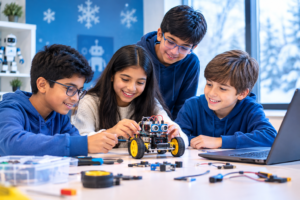
Combining AI with robotics can make learning even more hands-on. Children can explore how robots use sensors, instructions, and intelligent systems to interact with their surroundings.
Robotics projects can also encourage teamwork and creative thinking because students have to plan, build, test, and improve their solutions.
Responsible AI and Digital Awareness
Teaching children AI should not focus only on what technology can do. They should also understand that technology needs to be used responsibly.
Age-appropriate AI education can introduce topics such as privacy, responsible technology use, misinformation, fairness, and the importance of checking information.
These conversations help children become thoughtful technology users and creators rather than simply consumers of new tools.
How Expert Mentors Improve the Learning Experience
A mentor can make a major difference when children are learning technical subjects. Instead of simply following instructions, students can receive explanations based on their individual questions and challenges.
A good mentor encourages children to think independently. Rather than immediately fixing every problem, they can ask guiding questions that help students discover the solution themselves.
This approach can build confidence and independence over time.
Why Hands-On Projects Are Important
Children often remember concepts better when they use them to create something. A project gives them a reason to apply what they have learned.
Instead of learning a programming concept and immediately moving to another lesson, students can use it to build a small application, experiment, game, AI activity, or robotics project.
Projects Turn Learning Into Experience
Think about the difference between reading about riding a bicycle and actually riding one. AI education works in a similar way.
Reading about artificial intelligence can introduce concepts, but building projects allows children to experience those concepts directly.
How Parents Can Choose the Right AI Course
Parents should look beyond the course title when comparing artificial intelligence courses for kids. The quality of the learning experience depends on several factors, including teaching methods, instructor interaction, project work, curriculum structure, and age suitability.
A course should match the child’s current ability rather than overwhelming them with advanced concepts.
Check the Age and Skill Level
Children at different ages learn technology differently. A beginner course for a younger child should use simpler explanations and more visual activities, while older students may be ready for programming, data concepts, and more advanced AI projects.
Choosing an age-appropriate program can make learning more enjoyable and productive.
Look for Live Interaction
If interaction is important to your child, check whether the program includes live instructor-led sessions rather than only pre-recorded videos.
Ask whether students can ask questions, participate in discussions, receive project guidance, and communicate with their mentor during classes.
Look for Practical Projects
A course that includes hands-on projects can help children understand how theoretical concepts work in real situations.
Parents can ask what students actually build during the program and whether projects are adapted to their learning level.
Why Learnerbit Focuses on Interactive Technology Learning
Learnerbit brings together AI, coding, and robotics education in an online learning environment designed for children. Its approach focuses on making technical subjects engaging through live interaction, practical activities, and mentor guidance.
Rather than treating children as passive viewers, the learning experience encourages them to participate, experiment, ask questions, and create.
This approach can help children gradually become more confident when working with technology.
Learnerbit’s Live Interactive Learning Approach
Live interactive classes give children an opportunity to learn directly from mentors while participating in structured lessons.
Students can ask questions as they learn, receive feedback on their work, and discuss problems with their instructors. This creates a learning environment where children can actively participate rather than simply watch a screen.
For families looking for flexible technology education, live online learning can provide a useful balance between convenience and interaction.
Hands-On Learning With Learnerbit
Learnerbit emphasizes practical learning so children can apply concepts through projects and activities.
Whether students are exploring artificial intelligence, coding, or robotics, creating something gives them a reason to understand the underlying concepts. They can test their ideas, identify mistakes, and improve their work.
This project-based approach can make technical education feel more creative and rewarding.
AI, Coding, and Robotics for Ages 6–16
Children between ages 6 and 16 can have very different interests and learning needs. A technology program should therefore provide age-appropriate challenges instead of treating every learner the same.
Learnerbit’s programs are designed around children and young learners, helping them explore AI, coding, and robotics through structured online education.
The objective is not simply to teach a programming language or AI concept. It is to help children develop curiosity, logical thinking, creativity, and confidence with technology.
How Parents Can Support AI Learning at Home
Parents do not need to be programmers or AI experts to support their child’s learning. Showing interest in projects and asking children to explain what they built can make the learning experience more meaningful.
Simple questions such as “What does your project do?” or “How did you solve that problem?” encourage children to think about their work and communicate their ideas.
Parents can also encourage experimentation. If a child wants to change a project and see what happens, that curiosity should be treated as part of learning.
Building Confidence Through Technology Projects
One of the biggest benefits of project-based learning is the sense of achievement children can experience when they create something themselves.
A project may begin with an idea that seems difficult. After several attempts, the child sees the final result working. That experience can encourage them to approach the next challenge with greater confidence.
AI and coding education therefore has the potential to develop more than technical knowledge. It can also strengthen persistence and creative thinking.
The Future of AI Education for Children
Artificial intelligence is continuing to influence education, business, communication, entertainment, science, and many other areas. Children growing up in this environment will encounter AI throughout their academic and professional lives.
Introducing AI concepts early can help children become familiar with the technology in a structured environment. The goal is not to turn every child into an AI engineer, but to give them the knowledge and confidence to understand an increasingly technology-driven world.
Live interactive education can make that introduction more engaging by combining technology with human mentorship.
Why Start Artificial Intelligence Learning Early?
Children are naturally curious. They ask how things work, experiment with ideas, and enjoy discovering new possibilities. AI education can channel that curiosity into structured technology learning.
Starting early also gives children time to explore different interests. One child may enjoy coding, another may prefer robotics, while another may become fascinated by AI applications.
Early exposure allows children to discover what they enjoy instead of forcing them to choose a technology path later without any prior experience.
Make AI Learning More Interactive With Learnerbit
If your child is interested in artificial intelligence, coding, or robotics, interactive learning can provide a more engaging way to explore these subjects.
Join Learnerbit’s online AI, coding and robotics courses for kids. Live interactive classes, hands-on projects and expert mentors for ages 6–16.
With the right learning environment, children can move from simply using technology to understanding how it works and eventually creating with it.
Conclusion
Artificial intelligence courses for kids can introduce children to one of the most influential areas of modern technology while helping them develop problem-solving, logical thinking, creativity, and digital skills.
Live interactive classes make the experience more engaging because children can communicate with instructors, ask questions, receive feedback, and work on projects with real-time guidance.
For families exploring ai courses for kids in new jersey, online coding courses for kids, coding classes for kids, or online coding classes for kids, a live mentor-led program can provide a flexible way to build technology skills from home.
The most important part is to make learning enjoyable. When children are encouraged to experiment, build, ask questions, and solve problems, technology education becomes more than another class—it becomes an opportunity to create.
Frequently Asked Questions
1. What are artificial intelligence courses for kids?
Artificial intelligence courses for kids introduce children to AI concepts through age-appropriate lessons, coding activities, practical projects, and interactive learning. Depending on the program, students may explore machine learning, computer vision, chatbots, robotics, and other AI concepts.
2. Are AI courses suitable for beginners?
Yes. Beginner-friendly AI programs are designed to introduce concepts gradually without requiring advanced programming knowledge. Children can start with basic concepts and progress toward more complex activities as their skills improve.
3. Are there AI courses for kids in New Jersey?
Yes, families can explore online ai courses for kids in new jersey that provide live instructor-led learning from home. Online programs can offer flexibility while allowing children to interact with mentors during classes.
4. Why combine coding with artificial intelligence for kids?
Coding provides children with a foundation for understanding how software and AI-powered applications work. Coding classes for kids can develop logical thinking and programming skills that support future learning in artificial intelligence, robotics, game development, and other technology areas.
5. What does Learnerbit offer for children?
Learnerbit provides online AI, coding, and robotics learning for children ages 6–16. Its approach focuses on live interactive classes, hands-on projects, and expert mentor guidance to make technology learning engaging and practical.