Receiving a maths test or assessment back can be frustrating, especially when the result does not reflect the amount of effort a student believes they put into studying. However, a marked assessment can provide much more than a grade. It can show students exactly where their mathematical understanding, problem-solving approach or working process needs attention.
Learning how to use that feedback effectively can make future study more focused. A Math Tutor Adelaide can also help students examine their mistakes, identify patterns and turn assessment feedback into a practical learning plan.
Why Maths Feedback Is Useful
A maths assessment provides evidence about how a student approached different types of questions.
A student may discover that they understand the underlying concepts but lose marks through calculation errors. Another student may know the correct formulas but struggle to decide which method to use.
These are very different problems and should be addressed differently.
Instead of looking only at the final mark, students can review:
- Which questions were incorrect
- Which steps were missing
- Where marks were lost
- Whether the method was appropriate
- Whether calculations were accurate
- Whether the final answer was interpreted correctly
This creates a much clearer picture of what to practise next.
Do Not Treat Every Wrong Answer the Same
An incorrect answer does not always indicate a lack of mathematical understanding.
For example, a student may lose marks because of:
Conceptual misunderstanding
The student does not understand the mathematical principle behind the question.
Method selection
The student understands several techniques but chooses the wrong one.
Algebraic error
The correct approach is selected, but an algebraic manipulation goes wrong.
Calculation error
The mathematical method is correct, but an arithmetic or calculator mistake changes the answer.
Question interpretation
The student misunderstands what the question is asking.
Communication
The student reaches the right idea but does not show enough working or explanation.
Identifying the type of mistake makes revision much more targeted.
Create a Maths Mistake Log
A simple mistake log can become a useful revision tool.
After an assessment, students can record:
Question: What type of question was it?
Mistake: What went wrong?
Reason: Why did the mistake happen?
Correction: What should have been done?
Practice: What similar question should be attempted next?
The purpose is not to create a huge notebook of every mistake. It is to identify recurring patterns.
If a student repeatedly makes errors when rearranging equations, for example, that skill can become a priority for future practice.
Compare the Working, Not Just the Answer
Students sometimes look at the teacher’s solution and focus only on the final number.
However, the working often provides more useful information.
Compare:
Your method
with
The expected method
Then identify the exact point where the two approaches differ.
This can reveal whether the problem occurred at the beginning of the solution or near the end.
A student who reaches the correct formula but substitutes a value incorrectly has a different learning need from a student who does not recognise the appropriate mathematical concept at all.
Learn From Teacher Comments
Written feedback can sometimes seem brief, particularly when a teacher has marked many assessment papers.
Students should look for repeated comments or symbols that indicate particular weaknesses.
For example, feedback may highlight:
- Insufficient working
- Incorrect notation
- Calculation errors
- Missing units
- Poor interpretation
- Incorrect graph features
- Incomplete reasoning
Students can turn these comments into a personal checklist.
Before submitting their next assessment, they can review that checklist and deliberately check each area.
Use Feedback Before the Next Assessment
Feedback is most useful when it changes what a student does next.
If an assessment shows that a student has difficulty with a particular topic, the next study sessions can include targeted practice before moving on to unrelated material.
For example:
Assessment feedback: Errors with statistical calculations.
Next step: Review the relevant statistical method.
Practice: Complete several questions with different data sets.
Check: Compare working with solutions.
Follow-up: Attempt an unfamiliar application question.
This creates a clear connection between feedback and improvement.
Rework Questions Without Looking at the Solution
One useful technique is to return to an incorrect question after some time has passed.
Cover the original solution and attempt the problem again.
Ask:
Can I solve this independently now?
If the answer is yes, the original mistake may have been caused by carelessness or a temporary misunderstanding.
If the answer is no, the student may need further explanation or practice with the underlying concept.
This is more informative than simply reading the corrected answer.
Practise Similar Questions After Fixing a Mistake
Correcting one question is only the first step.
After understanding the mistake, students should attempt another question involving the same skill.
For example:
Original problem: Incorrect differentiation.
Step 1: Identify why the differentiation was wrong.
Step 2: Review the relevant rule.
Step 3: Complete a straightforward example.
Step 4: Attempt a more challenging example.
Step 5: Apply the method in an unfamiliar context.
This helps turn a correction into an actual skill.
Use Feedback to Improve Time Management
Assessment feedback can also reveal problems with time management.
A student may understand the Mathematics but spend too long on difficult questions and leave insufficient time for later sections.
After an assessment, students can consider:
- Which questions took the longest?
- Did I spend too much time on one problem?
- Did I leave questions incomplete?
- Did I rush towards the end?
- Did I have enough time to check my answers?
The next practice session can then include timed questions to develop a more effective pace.
Build Better Habits With Calculator Use
Calculator errors can sometimes appear as mathematical mistakes even when the underlying concept is understood.
Students should review whether they:
- Entered values correctly
- Used brackets appropriately
- Selected the correct calculator mode
- Copied results accurately
- Interpreted calculator output correctly
- Rounded at the appropriate stage
For SACE General Mathematics, official examination instructions require students to show appropriate working and steps of logic, while approved calculators may be used.
This means calculator use should support the mathematical process rather than replace clear working.
Feedback Is Important Across Different Maths Subjects
Students may receive different types of feedback depending on the Mathematics subject they study.
SACE General Mathematics focuses on practical problem-solving and includes applications such as financial management, statistical investigation, mathematical modelling, networks and matrices.
Stage 1 Mathematics provides a foundation for Stage 2 Mathematical Methods and Specialist Mathematics.
As a result, students should pay attention to the particular skills their subject requires rather than using a single revision strategy for every Mathematics course.
How a Math Tutor Adelaide Can Help With Assessment Feedback
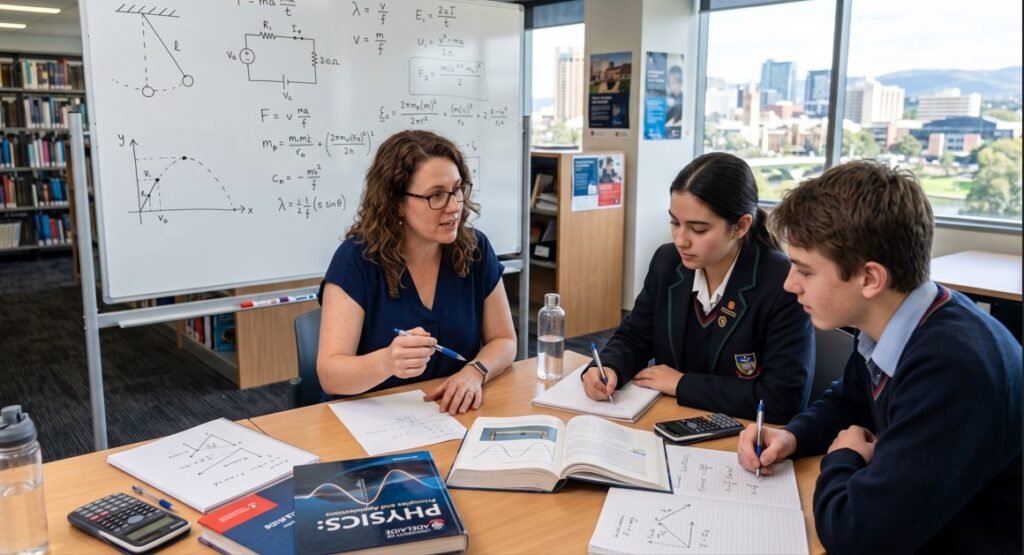
A Math Tutor Adelaide can help students go through previous assessments and identify patterns that may be difficult to recognise independently.
A tutoring session could involve:
- Reviewing incorrect questions
- Identifying repeated mistakes
- Re-explaining difficult concepts
- Reworking problems step by step
- Creating targeted practice questions
- Improving mathematical working
- Practising under time limits
- Preparing a personalised revision plan
Advanced Education provides private maths tuition online and in person for SACE and IB students across different year levels. Its Mathematics tutoring also includes support for subjects such as Mathematical Methods and Specialist Mathematics.
Turn One Assessment Into Future Practice
A single assessment can help shape several weeks of study.
For example, suppose a student identifies three main weaknesses:
Algebra: Needs more practice.
Graphs: Understands the basics but struggles with interpretation.
Calculations: Makes occasional avoidable errors.
The student can then create a study plan that addresses each area separately.
Instead of saying:
“I need to get better at maths.”
the student has three specific skills to work on.
This makes improvement much more manageable.
Ask Better Questions
Students can also become more effective learners by asking specific questions.
Instead of:
“I don’t understand this topic.”
they might ask:
“Why do I need to use this method here?”
or:
“Where did this value come from?”
or:
“How do I know which formula applies?”
or:
“Why is my graph different from the expected graph?”
Specific questions make it easier for teachers and tutors to identify the exact problem.
Develop a Personal Maths Checklist
Over time, students can build a checklist based on their own assessment history.
It might include:
Before solving:
- Have I read the whole question?
- Do I know what I need to find?
- Have I identified the relevant concept?
During solving:
- Am I using the correct method?
- Is my working clear?
- Are my calculations accurate?
Before submitting:
- Have I answered every part?
- Does the result make sense?
- Have I checked important calculations?
- Have I followed the required format?
A personal checklist can be especially useful before major assessments.
Make Improvement More Specific
Improving in Mathematics does not always mean studying for longer.
Sometimes the better approach is studying more specifically.
A student who already understands a topic may not benefit from repeatedly reviewing the same notes. They may instead need challenging application questions.
Another student may need to return to foundational algebra before attempting more advanced problems.
Understanding the difference allows study time to be used more effectively.
Final Thoughts
Maths feedback becomes valuable when students use it to change how they study.
Rather than focusing only on the mark, students can examine their working, identify recurring mistakes, reattempt incorrect questions and practise the specific skills that need improvement.
A Math Tutor Adelaide can provide additional guidance by helping students interpret assessment feedback and turn it into a practical study plan.
The goal is not to avoid every mistake. It is to understand mistakes well enough that they become opportunities to develop stronger mathematical skills.