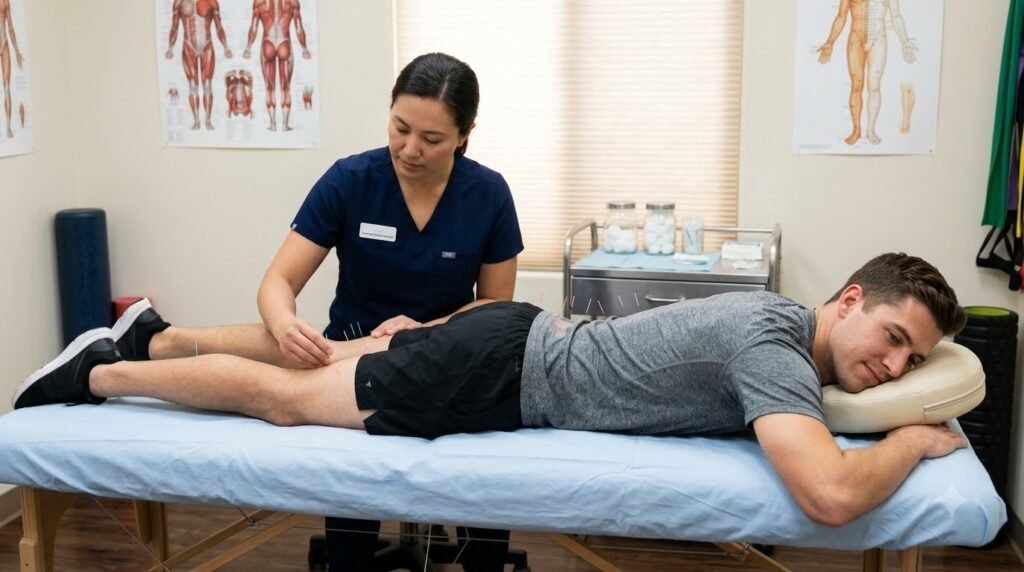
An unexpected pop in the hamstring, a persistent ache in the Achilles tendon, or a sharp twinge in the rotator cuff can bring months of rigorous athletic training to an abrupt halt. When an acute sprain occurs or chronic overuse turns into unyielding pain, standard sports medicine often provides limited pathways: passive rest, icing, corticosteroid injections, or heavy doses of anti-inflammatory medications. While these conventional methods may temporarily quiet surface symptoms, they often fail to stimulate tissue regeneration in poorly vascularized soft tissues.
For athletes looking to resolve the underlying structural damage rather than merely masking discomfort, utilizing clinical acupuncture for sports injuries provides an evidence-based method to accelerate biological tissue repair, break down restrictive scar tissue, and restore optimal neuromuscular function. Understanding how targeted needling works alongside your body’s natural regenerative systems can significantly shorten your recovery timeline and protect you from reinjury.
Why Acupuncture for Sports Injuries Targets Hard-to-Heal Tissues
Not all athletic tissues heal at the same rate. Understanding the unique biological limitations of tendons, ligaments, and deep myofascial sheaths clarifies why standard passive rest often results in lingering weakness.
Muscles possess a rich, dense network of capillary blood vessels, allowing them to recover from minor strains relatively quickly. In contrast, tendons and ligaments are bradytrophic tissues—meaning they have minimal natural blood flow. This low vascularity deprives injured connective tissue of the oxygen, amino acids, and growth factors required to rebuild damaged collagen matrices.
When an athlete relies solely on rest, the body frequently patches torn connective tissue with disorganized, brittle Type III collagen (scar tissue). This fibrotic tissue lacks the tensile strength and elasticity of healthy Type I collagen. Over time, these rigid adhesions restrict joint kinematics, forcing neighboring muscle groups to compensate and creating biomechanical vulnerabilities throughout the entire kinetic chain.
How Needling Stimulates the Three Stages of Tissue Repair
Orthopedic needling does not simply blunt pain perception; it systematically interacts with every stage of the body’s physiological healing cascade.
text
Acute Strain / Micro-Tear in Bradytrophic Tissue
│
▼
Needle Insertion & Micro-Stimulation (Mechanotransduction)
│
┌─────────────────┴──────────────────┐
▼ ▼
Axon Reflex & Vasodilation Fibroblast & Tenocyte Activation
(Nitric Oxide / CGRP Influx) (Type I Collagen Synthesis)
│ │
└─────────────────┬──────────────────┘
▼
Realigned, High-Tensile Tissue & Restored Elasticity
1. Acute Inflammatory Phase: Clearing Fluid Without Blunting Repair
Traditional ice and NSAID protocols shut down inflammation entirely, which modern sports science shows can delay long-term tissue regeneration.
Acupuncture takes a different approach: it regulates local microcirculation. Inserting fine needles around the perimeter of an acute injury triggers the release of calcitonin gene-related peptide (CGRP) and substance P. These neuropeptides promote controlled microvascular vasodilation, flushing out pooled metabolic waste and inflammatory edema while delivering the white blood cells necessary to clean cellular debris from the wound bed.
2. Proliferative Phase: Stimulating Tenocytes and Fibroblasts
During the secondary stage of recovery, the body must produce new structural proteins to close micro-tears.
When a solid acupuncture needle is inserted into damaged tendon tissue and gently rotated, it grasps surrounding collagen fibers. This mechanical force, known as mechanotransduction, sends physical signals directly into local fibroblasts and tenocytes (tendon cells). In response, these cells ramp up intracellular production of growth factors and initiate the synthesis of robust, organized collagen.
3. Remodeling Phase: Aligning Collagen Along Lines of Stress
The final stage of rehabilitation requires newly formed collagen to align parallel to the direction of muscle pull.
When treating chronic recalcitrant conditions, using targeted acupuncture for sports injuries triggers local micro-trauma that restarts the stalled repair process in stubborn tissue, encouraging older, tangled scar tissue to remodel into flexible, functional bands that withstand intense athletic loading.
Common Athletic Conditions That Benefit from Targeted Needling
Because sports injuries involve both local tissue tears and broader kinetic compensations, clinical acupuncture treats both the isolated site of pain and the surrounding neuromuscular framework.
Chronic Tendinopathies
Overuse injuries like Achilles tendinitis, patellar tendinopathy (jumper’s knee), lateral epicondylitis (tennis elbow), and rotator cuff tendinosis involve degenerative changes rather than simple acute inflammation. Deep tendon needling stimulates localized neovascularization—the growth of new micro-capillaries—which restores cellular nutrition to degenerate tendon fibers that have stopped healing on their own.
Ligament Sprains and Joint Instability
Inversion ankle sprains and knee ligament strains stretch stabilizing joint capsules beyond their normal limits. Peri-articular needling relieves reactive capsular swelling, reduces impingement pain, and accelerates ligamentous remodeling, helping restore structural stability to the joint capsule.
Muscle Strains and Fascial Adhesions
Groin pulls, hamstring strains, and calf tears frequently leave behind dense, hyperirritable trigger points that maintain chronic tension on associated joints. Targeted motor point needling elicits a localized neuromuscular twitch response that instantly releases shortened muscle fibers and restores full active range of motion.
Shin Splints and Periosteal Irritation
Medial tibial stress syndrome (shin splints) occurs when the deep flexor muscles of the lower leg pull excessively on the tibial periosteum. Periosteal needling along the medial border of the tibia down-regulates local bone-sheath inflammation and releases tension in the tibialis posterior and soleus muscles.
The Role of Motor Point Needling in Preventing Recurrent Injuries
Many athletes experience a frustrating cycle of recurring strains because their underlying movement dysfunction was never addressed. When a muscle is injured, the central nervous system often responds by neurologically inhibiting it to prevent further damage, while forcing synergist muscles to overwork.
text
Primary Muscle Injury (e.g., Hamstring Strain)
│
▼
Central Nervous System Inhibition (Muscle Remains Weak)
│
▼
Synergists & Compensators Overworked (e.g., Adductors / Lower Back)
│
▼
Biomechanical Imbalance & Inevitable Re-Injury
Sports medicine acupuncturists locate the motor point of an inhibited muscle—the precise anatomical site where the motor nerve enters the muscle belly. By applying low-frequency electrical stimulation (2–4 Hz) directly through the needle, the practitioner re-establishes neuromuscular recruitment. This “wakes up” the dormant muscle, rebalances reciprocal inhibition across the joint, and ensures that prime movers fire correctly during complex athletic movements.
Specialized Modalities Used in Sports Rehabilitation
Clinical sessions integrate several targeted modalities to maximize recovery:
- Electro-Acupuncture: Delivering microcurrent through needles placed at the origin and insertion of injured tissues increases local cellular ATP production, accelerates cellular repair, and triggers the systemic release of endorphins for natural pain control.
- Decompressive Myofascial Cupping: By applying negative suction over tight fascial compartments, cupping separates adhered connective tissue layers and draws stagnant fluid into lymphatic channels for rapid drainage.
- Gua Sha (Instrument-Assisted Soft Tissue Mobilization): Light scraping techniques create controlled micro-petechiae, stimulating an immune response that breaks down superficial scar tissue and smooths out fascial grittiness.
Return-to-Play Timeline: What Athletes Should Expect
A structured plan utilizing acupuncture for sports injuries ensures that collagen remodeling keeps pace with athletic loading demands.
| Injury Classification | Severity Example | Expected Treatment Frequency | Typical Recovery Window |
| Grade I (Mild Strain/Sprain) | Minor hamstring pull, mild ankle roll | 2 sessions per week for 2–3 weeks | 10 to 21 days |
| Grade II (Moderate Tear) | Partial rotator cuff tear, severe knee sprain | 2 sessions per week for 4–6 weeks | 4 to 8 weeks |
| Chronic Tendinopathy | Longstanding Achilles or patellar tendinitis | 1–2 sessions per week for 6–10 weeks | 8 to 12 weeks |
| Post-Surgical Rehab | ACL reconstruction, meniscus repair recovery | 1 session per week alongside physical therapy | 3 to 6 months |
Common Rehabilitation Mistakes to Avoid
- Returning to Heavy Loading Too Quickly: Pain relief typically occurs before the structural integrity of newly synthesized collagen is fully restored. Progress loading gradually under the supervision of a coach or physical therapist.
- Relying on Corticosteroid Injections: While cortisone provides rapid short-term pain relief, repeated injections degrade local collagen architecture and increase the long-term risk of catastrophic tendon ruptures.
- Treating Only the Pain Site: Ignoring upstream and downstream dysfunctions—such as treating a knee issue without addressing an unstable ankle or a locked hip—leads directly to reinjury.
- Neglecting Active Rehabilitation: Passive treatments must be paired with progressive resistance training to teach newly remodeled soft tissue how to handle dynamic kinetic forces.
Integrating orthopedic acupuncture for sports injuries into your overall rehabilitation strategy ensures that you address both local tissue damage and systemic kinetic imbalances.
Frequently Asked Questions
Can acupuncture heal a fully torn ligament or tendon?
No. A complete, full-thickness tear (Grade III rupture) generally requires surgical repair. However, acupuncture is highly beneficial during post-surgical rehabilitation to reduce swelling, manage post-operative pain, and accelerate scar tissue remodeling around the surgical site.
How quickly after an acute sports injury should you get needled?
You can receive treatment within 24 to 48 hours of an acute injury. Early treatments use distal points away from the swollen joint to manage pain and systemic inflammation, followed by gentle local needling once the immediate swelling begins to clear.
Does sports injury acupuncture hurt on an inflamed joint?
Most needles produce only a mild sensation of heaviness, warmth, or a momentary twitch. Practitioners do not insert needles directly into acutely hypersensitive nerve endings, but rather place them strategically into surrounding motor points and vascular beds to ensure comfort.
How many sessions does it take to resolve chronic tendinitis?
Longstanding tendinopathies usually require 6 to 10 sessions. Because chronic tendon degeneration involves stimulating new cellular collagen production, the biological repair process typically takes 6 to 8 weeks of consistent, cumulative stimulation.
Can you combine acupuncture with physical therapy exercises?
Yes. Combining acupuncture with active physical therapy is highly recommended. Receiving needling prior to exercise therapy relaxes guarded muscles and restores joint range of motion, allowing you to perform corrective strengthening exercises with better biomechanical form and less pain.