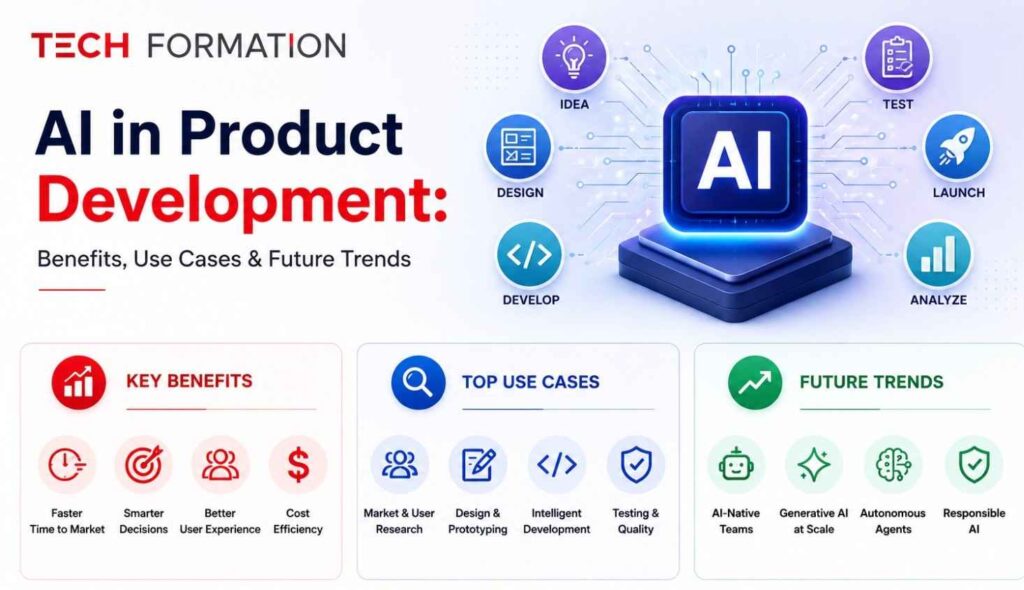
Building a successful product is never simple. Customer expectations change fast, markets move quickly, and businesses need to release updates constantly. To keep up, many companies now use AI in product development to make smarter and faster decisions. A few years ago, AI was mostly discussed in tech labs and conferences. Today, product managers, developers, designers, and startup founders use it in their daily work because it solves real problems. It helps save time, improve accuracy, and understand users better.
Still, AI is not magic. It cannot build great products on its own. But it can help teams make better decisions throughout the product development process.
How AI is changing the product development process
Traditional product development often takes a lot of time. Teams rely on meetings, manual research, customer feedback, and assumptions to decide what users want. AI helps speed up this process by quickly analyzing large amounts of data and finding useful patterns.
For example, AI tools can show which features customers use most, where users face problems, or why they leave an app. This helps teams make faster decisions, fix issues earlier, and improve products more efficiently. That is why more businesses are using AI in product development today.
Major Benefits Businesses Are Experiencing
The benefits of AI go far beyond automation. Businesses are using AI to improve planning, understand customer behavior better, and make product development more efficient.
Faster market research
Research that once required days of manual work can now happen much faster. AI tools scan customer reviews, competitor updates, industry reports, and online discussions to identify trends. That speed matters because markets rarely stay still for long.
Better product decisions
One common problem in product management is bias. Teams sometimes build features based on internal opinions instead of real customer needs.
AI helps reduce that issue by relying on behavioral data and usage patterns. It shows what users actually do, not just what they say.
Improved Development Efficiency
AI tools help developers work faster by handling repetitive tasks. They can suggest code, find bugs, and improve performance during development. This does not replace developers. It simply gives them more time to focus on important work and build better products faster.
Smarter Forecasting
Predicting customer demand is not always easy. AI helps businesses make better forecasts by analyzing past data, customer behavior, and buying trends. This helps companies plan product releases more effectively and avoid wasting time and development costs on the wrong features or ideas.
Real-World Use Cases of AI in Product Teams
AI is no longer just a theoretical idea. Many companies already use it in practical ways to improve product development and daily workflows.
Customer Feedback Analysis
Businesses receive a lot of customer feedback through reviews, emails, chats, and social media. Reading all of it manually can take a long time.
AI helps by sorting and analyzing this feedback automatically. It can find common problems, customer opinions, and popular feature requests, so product teams know what users need most.
Personalized Product Experiences
Many apps and platforms now use AI to create more personalized user experiences. This includes product recommendations, custom dashboards, personalized notifications, and onboarding based on user behavior. As a result, products feel more useful and relevant because they adapt to the needs and habits of each user.
Predictive Maintenance in Hardware Products
AI helps manufacturing and hardware companies detect equipment problems before they happen. Sensors collect machine data, and AI systems identify unusual patterns that may lead to failures. This helps businesses reduce downtime, avoid unexpected breakdowns, and lower maintenance costs.
Prototype Testing
AI testing tools help teams check how users may interact with a new feature before launch. These tools can identify areas where users might get confused or stop using the product. This helps teams improve the user experience early and fix problems before the product goes live.
The Growing Role of Generative AI
Generative AI is becoming a bigger part of product development. Teams use it to create wireframes, write documents, summarize meetings, generate user stories, and brainstorm new feature ideas. Some companies even use AI during sprint planning.
AI is not perfect, so human review still matters. But it helps teams work faster and gives them a strong starting point. Instead of using separate AI tools occasionally, many businesses now use software where AI is built directly into their daily workflows and development systems.
Challenges Businesses Should Not Ignore
AI offers many benefits, but businesses also need to be careful about a few challenges. AI systems depend on good-quality data, so inaccurate or incomplete data can lead to poor results. Privacy and data security are also important when handling customer information.
Another risk is relying too much on automation. AI can support product decisions, but human thinking and creativity still matter. The best teams use AI as a helpful tool, not as a complete replacement for human judgment.
Future trends shaping AI-driven product development
The future of AI in product development will likely focus on deeper collaboration between humans and intelligent systems.
A few trends are already becoming visible:
- AI-powered digital twins for product simulation
- More advanced predictive analytics for customer behavior
- Automated UX optimization based on live user interactions
- Faster no-code and low-code product experimentation
- Real-time product adaptation using behavioral learning
Another important trend is explainable AI. Businesses increasingly want systems that can clearly explain why a recommendation was made. Transparency builds trust, especially when AI influences major product decisions.
Conclusion
AI in product development is no longer just about future ideas. Businesses already use it to understand customer needs, improve workflows, speed up development, and create more personalized products. At the same time, AI cannot replace human creativity and decision-making. The best products still come from teams that combine smart technology with real customer understanding.