Market Overview:
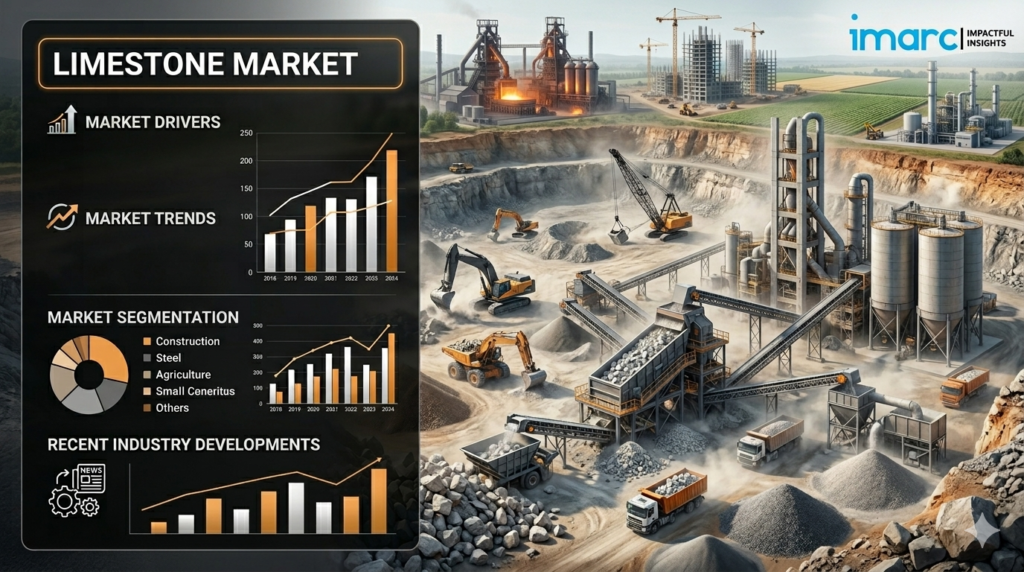
The limestone market is experiencing rapid growth, driven by escalating global construction and infrastructure development, expanding metallurgical applications in steel production, and rising demand for flue gas desulfurization and environmental remediation. According to IMARC Group’s latest research publication, “Limestone Market Size, Share, Trends and Forecast by Type, Size, End-Use Industry, and Region, 2026-2034”, the global limestone market size was valued at USD 88.78 Billion in 2025 and is projected to reach USD 125.04 Billion by 2034, exhibiting a CAGR of 3.59% during the forecast period 2026-2034.
This detailed analysis primarily encompasses industry size, business trends, market share, key growth factors, and regional forecasts. The report offers a comprehensive overview and integrates research findings, market assessments, and data from different sources. It also includes pivotal market dynamics like drivers and challenges, while also highlighting growth opportunities, financial insights, technological improvements, emerging trends, and innovations. Besides this, the report provides regional market evaluation, along with a competitive landscape analysis.
Download a sample PDF of this report: https://www.imarcgroup.com/limestone-market/requestsample
Our report includes:
- Market Dynamics
- Market Trends and Market Outlook
- Competitive Analysis
- Industry Segmentation
- Strategic Recommendations
Growth Factors in the Limestone Market
- Escalating Global Construction and Infrastructure Development
- Expanding Metallurgical Applications in Steel Production
Beyond its core utility in masonry, high-calcium limestone plays a critical operational role within modern heavy metallurgy, particularly as a chemical fluxing agent in steel manufacturing. In blast furnaces and basic oxygen furnaces, the mineral reacts with silica and alumina impurities to form liquid slag, which can be easily separated from the refined molten metal. Metallurgy contributes approximately 6.8 percent of global limestone revenue, demonstrating its heavy integration into heavy industrial supply chains. Industrial enterprises like ArcelorMittal and Nippon Steel maintain continuous high-volume contracts for specialized raw materials to preserve manufacturing efficiencies. Additionally, international trade partnerships and regional industrial zones catalyze localized processing activities. As manufacturing centers expand their production thresholds to feed global logistics, automotive networks, and heavy machinery production, the baseline consumption of structural chemical fluxes in modern refining operations undergoes a parallel industrial expansion worldwide.
- Rising Demand for Flue Gas Desulfurization and Environmental Remediation
Rigid international environmental regulations concerning atmospheric emissions have transformed limestone into a vital commodity for corporate compliance strategies. High-calcium limestone, which comprises nearly seventy percent of the broader industry product classification, is extensively utilized in flue gas desulfurization systems across coal-fired power utilities and manufacturing plants. The chemical compound absorbs toxic sulfur dioxide emissions from exhaust streams, converting industrial pollutants into synthetic gypsum. This eco-remediation utility is reinforced by expanding investments in water treatment infrastructure, where municipal and industrial facilities use hydrated lime for critical pH corrections and heavy metal precipitation. These green protocols are driven by worldwide environmental clean-up initiatives requiring massive capital deployments to guarantee sanitation. Consequently, chemical organizations like Lhoist and Carmeuse are continually adjusting output to meet the surging demands of power generation facilities attempting to minimize their total ecological footprints.
Key Trends in the Limestone Market
- Adoption of Green Cement and Blended Clinker Formulations
A major paradigm shift involves the deployment of blended formulations that incorporate finely ground limestone as a supplementary cementitious material to mitigate processing footprints. Multinational corporations such as Holcim, Heidelberg Materials, and UltraTech are commercializing Portland-Limestone Cement varieties that substitute substantial volumes of carbon-intensive clinker with ground calcium carbonate. These specialized formulations allow manufacturing entities to reduce operational energy requirements while matching the structural durability performance of traditional building materials. This development is heavily influenced by cross-border regulations like the European Union Carbon Border Adjustment Mechanism, which penalizes high-emission materials. By standardizing these blended products across commercial supply chains, industrial suppliers are successfully altering downstream raw material specifications. The integration of alternative mineral blends serves as a prominent corporate benchmark, shifting the mineral processing focus toward finely graded, high-purity inputs for low-carbon manufacturing.
- Carbon Capture Integration at Calcined Lime Processing Plants
Industrial processing facilities are actively integrating advanced carbon capture, utilization, and storage systems directly into their calcination kilns to neutralize residual factory emissions. Landmark initiatives, such as the oxy-fuel calcination retrofits at major processing sites in Europe, demonstrate the practical deployment of automated calcium looping technology to isolate carbon dioxide during mineral thermal decomposition. These large-scale pilot systems capture high-purity gaseous emissions before they reach the atmosphere, redirecting the captured byproducts into underground storage reservoirs or utilizing them in downstream chemical synthesis. Lime producers are dedicating significant portions of their capital budgets to implement these advanced carbon capture systems to insulate operations from rising industrial carbon taxes. This engineering trend showcases a structural transformation in bulk mining operations, where traditional processing techniques are being heavily upgraded with climate-tech innovations to achieve modern sustainable manufacturing profiles.
- Proliferation of Ultra-Fine Nano-Precipitated Calcium Carbonate
The commercial manufacturing sector is experiencing an unprecedented surge in the utilization of specialized nano-precipitated calcium carbonate across high-performance applications. Industrial processors like Minerals Technologies and Omya have engineered advanced structural particle-size management techniques to produce ultra-fine mineral grades designed for modern polymers, automotive rubber tires, and pharmaceutical coatings. These synthetic particles act as functional reinforcing agents that modify final product viscosity, structural impact resistance, and overall aesthetic brightness, commanding premium values over standard ground products. This material science innovation allows manufacturing operations to replace costly synthetic resins with sustainable mineral alternatives without degrading final product integrity. As high-tech consumer electronics and specialized medical packaging require sophisticated material tolerances, the integration of precisely engineered mineral additives has emerged as a high-margin opportunity, redefining standard quarry outputs into highly technical, chemical-grade performance inputs.
Leading Companies Operating in the Global Limestone Industry:
- AMR India Limited
- Carmeuse
- Graymont Limited
- Imerys (Belgian Securities B.V.)
- M. Huber Corporation
- LafargeHolcim
- Minerals Technologies Inc.
- Mitsubishi Materials Corporation
- Schaefer Kalk
- Sumitomo Osaka Cement Co. Ltd.
- Eliotte Stone Co. Inc.
Limestone Market Report Segmentation:
Breakup By Type:
- Magnesian Limestone
- High-Calcium Limestone
High-calcium limestone accounts for the majority of shares (~69.5% in 2024) owing to its superior CaCO3 purity (>95%), making it indispensable for cement production, steel flux, FGD, and water treatment.
Breakup By Size:
- Crushed Limestone
- Calcined Limestone (PCC)
- Ground Limestone (GCC)
Crushed limestone dominates the size segment due to its widespread use in cement manufacturing, road construction, and infrastructure projects.
Breakup By End-Use Industry:
- Construction
- Metallurgy
- Agriculture
- Water and Wastewater Treatment
- Paper and Pulp
- Chemical
- Others
Construction leads the end-use segment with approximately 82.0% market share in 2024, driven by its essential role in cement, concrete, and global infrastructure development.
Breakup By Region:
- North America (United States, Canada)
- Asia Pacific (China, Japan, India, South Korea, Australia, Indonesia, Others)
- Europe (Germany, France, United Kingdom, Italy, Spain, Russia, Others)
- Latin America (Brazil, Mexico, Others)
- Middle East and Africa
Asia Pacific holds the leading position with over 56.0% market share in 2024, driven by massive urbanisation, cement demand, and infrastructure investment in China, India, and Southeast Asia.
Note: If you require specific details, data, or insights that are not currently included in the scope of this report, we are happy to accommodate your request. As part of our customization service, we will gather and provide the additional information you need, tailored to your specific requirements. Please let us know your exact needs, and we will ensure the report is updated accordingly to meet your expectations.
About Us:
IMARC Group is a global management consulting firm that helps the world’s most ambitious changemakers to create a lasting impact. The company provide a comprehensive suite of market entry and expansion services. IMARC offerings include thorough market assessment, feasibility studies, company incorporation assistance, factory setup support, regulatory approvals and licensing navigation, branding, marketing and sales strategies, competitive landscape and benchmarking analyses, pricing and cost research, and procurement research.
Contact Us:
IMARC Group
134 N 4th St. Brooklyn, NY 11249, USA
Email: sales@imarcgroup.com
Tel No:(D) +91 120 433 0800
United States: +1-201971-6302