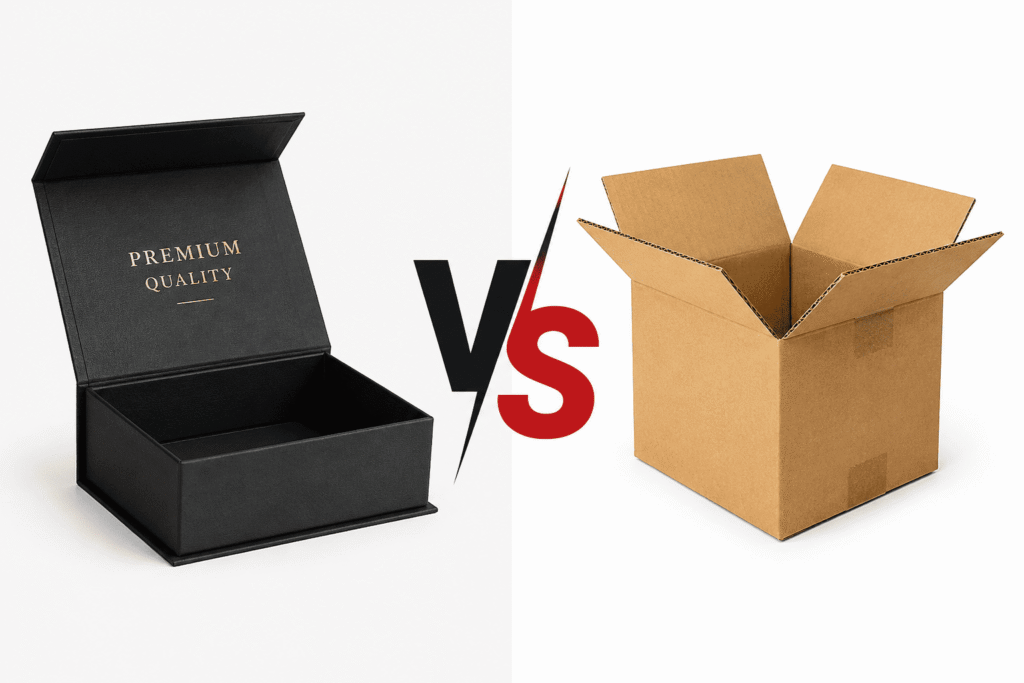
Rigid vs Corrugated Boxes
In the competitive markets of the United States and Canada, packaging has evolved into a strategic business tool rather than just a protective layer. Whether you run an eCommerce store, a retail brand, or a subscription service, your packaging choice can directly influence customer satisfaction, shipping costs, and brand perception. Among the most widely used options, rigid boxes and custom corrugated boxes stand out as two distinct solutions with different strengths.
This article explores their features, benefits, and ideal use cases to help you determine which packaging solution best fits your business needs.
What Are Rigid Boxes?
Rigid boxes, often called set-up boxes, are made from thick, high-density paperboard that maintains its shape without folding. These boxes are known for their durability and luxurious appearance, making them a preferred choice for premium brands.
They are commonly used for products such as electronics, cosmetics, jewelry, and high-end gifts. The structure of rigid packaging allows for advanced customization, including magnetic closures, embossing, foil stamping, and soft-touch finishes.
Key Features
- Strong and durable structure
- Premium and high-end appearance
- Fully customizable design options
- Enhances unboxing experience
- Ideal for luxury and fragile products
Despite these advantages, rigid boxes come with higher production and shipping costs. Their non-collapsible nature also means they require more storage space.
What Are Corrugated Boxes?
Corrugated boxes are made from fluted paper sandwiched between two linerboards. This design creates a lightweight yet structure that is ideal for shipping and storage.
These boxes are widely used across industries due to their affordability and practicality. From small online businesses to large-scale logistics companies, corrugated packaging plays a vital role in product transportation.
Key Features
- Lightweight
- Excellent shock absorption
- Cost-effective for bulk production
- Easy to store and transport (flat-packed)
- Suitable for shipping and logistics
While corrugated boxes may not offer the same luxury feel as rigid packaging, they provide unmatched efficiency for delivery purposes.
Rigid vs Corrugated Boxes: A Detailed Comparison
Choosing between these two packaging types depends on several business factors. Below is a clear comparison to help you evaluate:
1. Durability and Protection
- Rigid boxes offer a solid and firm structure, ideal for delicate and high-value items.
- It provide better cushioning and impact resistance during shipping.
2. Cost Efficiency
- Rigid packaging is more expensive due to materials and design complexity.
- Corrugated packaging is budget-friendly and suitable for high-volume use.
3. Branding and Presentation
- It deliver a premium look that enhances brand value.
- It can be printed and customized but are more functional than luxurious.
4. Storage and Shipping
- It take up more space and increase shipping costs.
- Corrugated boxes are collapsible, saving space and reducing logistics expenses.
5. Customization Options
- Rigid packaging supports high-end finishes and structural designs.
- Corrugated packaging allows branding through printing and structural variations.
When Should You Choose Rigid Boxes?
Rigid boxes are the right choice when your brand focuses on presentation and customer experience. They are particularly effective for:
- Luxury and high-end products
- Gift packaging
- Retail display items
- Electronics and premium accessories
If your goal is to create a memorable unboxing experience that customers associate with quality, rigid packaging delivers strong results.
When Should You Choose Corrugated Boxes?
Corrugated box packaging are ideal for businesses that prioritize efficiency, protection, and affordability. They are best suited for:
- eCommerce shipping
- Bulk product packaging
- Subscription boxes
- Warehouse storage and logistics
For businesses operating in the USA and Canada, where shipping distances can be long and costs can add up quickly, corrugated packaging offers a practical solution.
Combining Both for Better Results
Many successful brands use a hybrid packaging strategy. A product may be placed inside a rigid box for presentation and then packed into a corrugated box for shipping.
This approach offers several advantages:
- Enhanced product protection
- Premium customer experience
- Reduced damage during transit
- Balanced cost and branding
By combining both packaging types, businesses can maximize efficiency without compromising on quality.
Sustainability Considerations
Eco-friendly packaging is becoming increasingly important for consumers in North America. Both rigid and corrugated packaging boxes have environmental impacts, but corrugated packaging is generally more recyclable and widely accepted in recycling systems.
However, rigid packaging boxes are often reused by customers due to their durability, which can extend their lifecycle.
To improve sustainability, businesses can:
- Use recyclable materials
- Minimize excess packaging
- Opt for eco-friendly printing methods
- Encourage customers to reuse packaging
Final Thoughts
There is no single winner when comparing rigid and corrugated packaging. The right choice depends on your business model, product type, and brand positioning. Rigid packaging boxes excel in presentation and luxury appeal, while corrugated boxes dominate in cost-efficiency and shipping performance.
For businesses looking to strike a balance between quality and affordability, exploring flexible packaging solutions is key. Many companies today are turning to cheap custom boxes as a smart way to maintain branding while keeping expenses under control.