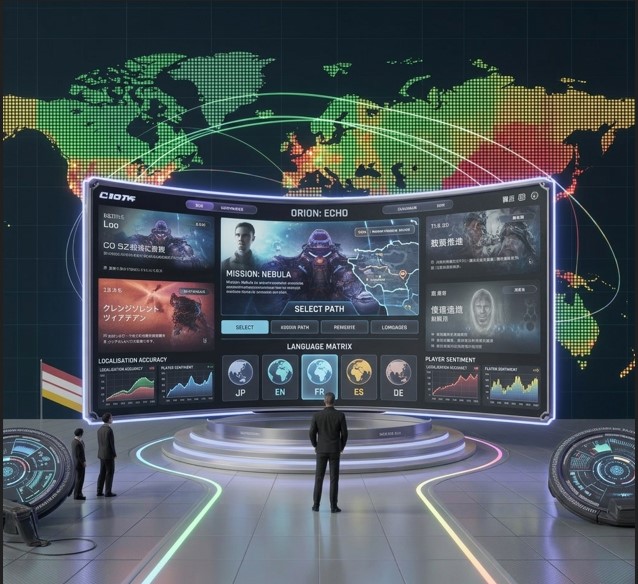
A global launch is no longer a milestone—it’s the baseline. Yet many games still feel “translated” instead of native, creating friction that quietly erodes retention and revenue. In 2026, game localisation is the system that determines whether your game resonates across cultures or gets lost in translation.
The industry context is clear. The global games market is projected to reach $221 billion by 2026 (Newzoo). High-quality game localisation can contribute up to 28% revenue uplift (Nimdzi Insights), while 16.11% of Steam reviews mention localization quality. Critically, failures in LQA for games can reduce retention by 20–40% (GameDeveloper.com).
This guide breaks down the frameworks, workflows, and technical decisions that turn localisation into a competitive advantage.
What Is Game Localisation?
Game localisation is the end-to-end adaptation of a video game for different languages, regions, and cultural contexts. It blends linguistic accuracy with creative and technical execution to deliver a seamless player experience.
It typically includes:
- Transcreation (creative rewriting for cultural fit)
- UI/UX localisation
- Audio and voice-over adaptation
- Culturalisation
- Technical adjustments
- LQA testing
A reliable structure for game localisation is the GILT framework:
- Globalization: Planning for global distribution
- Internationalization (i18n): Preparing code and systems for multiple languages
- Localization: Adapting content for specific markets
- Translation: Converting language
This ensures localisation is built into development—not layered on afterward.
Why Game Localisation Is a Strategic System
- Simultaneous Global Launches
Modern games launch across regions at once. Without strong game localisation, these releases lose impact and accessibility.
- Player Experience as a Growth Driver
Localization directly affects how players understand, navigate, and emotionally connect with a game.
- Revenue and Retention Impact
Localized experiences increase session length, retention, and in-game spending.
- Cultural Relevance
Games are cultural experiences. Game localisation ensures content resonates rather than alienates.
Translation vs Game Localisation
| Aspect | Translation | Game Localisation |
| Scope | Text | Entire experience |
| Focus | Language | Culture + UX + technical |
| Output | Literal | Native-feeling |
| Goal | Understanding | Immersion |
Translation communicates meaning. Game localisation delivers experience.
The Four Pillars of Game Localisation
- Linguistic Precision
Accurate translation supported by glossaries and style guides ensures consistency.
- Creative Transcreation
Transcreation adapts humor, tone, and references so they feel natural in each market.
- Technical Infrastructure
- Internationalization (i18n)
- Unicode support
- Flexible UI design
These elements ensure the game can technically support localization.
- Quality Assurance (LQA)
LQA testing validates the localized experience in real gameplay conditions.
The Game Localisation Workflow (Deep Dive)
Step 1: Content Mapping
All text, UI elements, and audio assets are identified and categorized. Context is critical here to avoid translation errors later.
Step 2: Internationalization (i18n)
Developers prepare systems for multilingual support:
- Externalized text strings
- Locale-aware formatting
- Scalable UI layouts
Step 3: Localization Kit Development
A localization kit provides:
- Screenshots and gameplay videos
- Character profiles and tone guidelines
- UI constraints and character limits
This reduces ambiguity for translators.
Step 4: Translation and Transcreation
Linguists adapt content while preserving meaning, tone, and player intent.
Step 5: Integration
Localized assets are implemented into the game build using engine pipelines.
Step 6: LQA Testing
LQA for games ensures:
- Text displays correctly
- UI functions properly
- Audio aligns with visuals
- Cultural context is appropriate
Step 7: Continuous Localisation
Live-service games require ongoing updates, seasonal events, and new content localization.
Case Studies: What Works and What Fails
Cyberpunk 2077
A large-scale game localisation effort across 15 languages encountered voice synchronization issues in certain regions. Early feedback showed reduced immersion, but improved LQA testing helped recover player trust.
Genshin Impact
A leading example of effective game localisation, this game used region-specific cultural events and transcreation to increase retention by 35%.
Pokémon GO
Localization inconsistencies in naming and cultural adaptation led to confusion and backlash, reinforcing the importance of consistency.
Technical Foundations That Support Game Localisation
Internationalization (i18n)
The backbone of game localisation:
- Externalized text
- Locale-aware formatting
- Support for pluralization rules
Unicode Support
Ensures compatibility with global languages including Asian and right-to-left scripts.
Flexible UI Design
Dynamic layouts prevent text overflow and maintain usability across languages.
Tools and Technology in Game Localisation
Translation Management Systems (TMS)
Centralized platforms for managing localization workflows.
Translation Memory (TM)
Stores previous translations to ensure consistency and efficiency.
AI-Assisted Localisation
AI accelerates translation but requires human oversight for nuance and cultural accuracy.
Engine Integration
Modern engines like Unity and Unreal support real-time localization updates.
Key Challenges in Game Localisation
Contextual Ambiguity
Text strings often lack context, leading to incorrect translations.
Text Expansion
Languages like German or Spanish can expand text length, affecting UI design.
Cultural Sensitivity
Content must be adapted to avoid misunderstanding or offense.
Humor and Tone
Humor rarely translates directly and requires creative adaptation.
Live-Service Complexity
Continuous updates increase localization workload and complexity.
Best Practices for Game Localisation
- Start localisation during development
- Build strong internationalization (i18n)
- Provide detailed localization kits
- Focus on transcreation, not just translation
- Conduct rigorous LQA testing
- Design flexible UI systems
2026 Trends Shaping Game Localisation
Real-Time Localisation
Live translation in multiplayer and social gaming environments.
AI + Human Hybrid Workflows
Combining speed with cultural intelligence.
Continuous Localisation Pipelines
Always-on localization for live-service games.
Voice AI Integration
Scalable dubbing solutions for global releases.
Regional Personalization
Dynamic content tailored to specific markets.
The Business Impact of Game Localisation
In 2026, game localisation directly influences:
- Market expansion
- Player retention
- Revenue growth
- Brand perception
It is no longer a supporting function—it is a strategic driver of success.
Frequently Asked Questions
What is game localisation?
It is the process of adapting games for different languages and cultures.
Why is game localisation important?
It improves player engagement, retention, and revenue.
What is LQA testing?
It ensures localization quality within the game environment.
Can AI replace game localisation?
No, human expertise is essential for cultural accuracy.
When should localisation start?
At the beginning of development.
Ready to Build a Truly Global Game?
If your goal is to create a game that resonates across cultures, game localisation is essential. It transforms your game from a local product into a global experience that players genuinely connect with.
About the Author
Orion Translations is the trusted language partner for global corporations and digital entertainment companies. We specialize in professional video game localisation services, delivering accurate, culturally adapted, and technically precise solutions for game developers and publishers worldwide. By combining linguistic expertise with interactive media understanding, Orion ensures your games resonate with players across languages and cultures. Visit www.oriontranslations.com to learn more about our services.