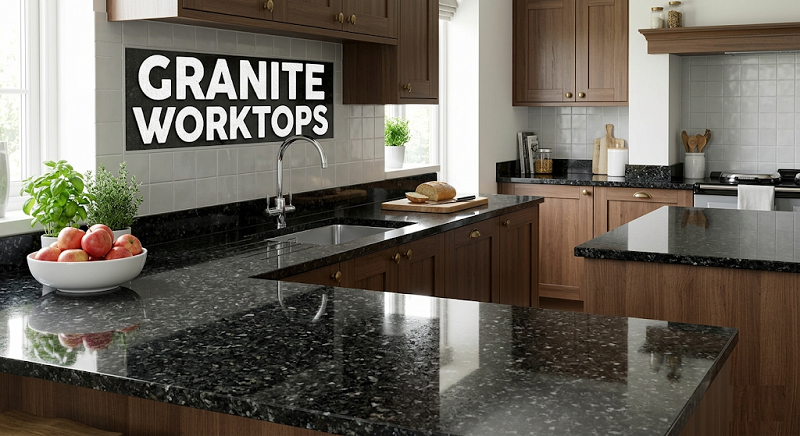
Walk into almost any kitchen showroom across the UK and you will spot granite worktops within seconds. They sit there, gleaming quietly under the lighting, with that unmistakable depth and weight that no man-made material has ever quite managed to replicate. And yet, despite decades of competition from engineered stone, laminate, and composite alternatives, granite continues to hold its own as the go-to choice for homeowners who want something that genuinely lasts.
But what makes granite worktops so popular in British kitchens? Is it purely aesthetics, or is there something more practical driving the demand? The honest answer is that it is both, and a few other reasons besides.
What Exactly Is Granite?
Granite is a naturally occurring igneous rock formed deep within the earth over millions of years. It is composed primarily of quartz, feldspar, and mica, which is what gives it those distinctive flecks and veining patterns you see running through the surface. Because it forms under immense heat and pressure, granite is extraordinarily hard and dense, qualities that translate directly into real-world durability in a kitchen setting.
No two slabs of granite are ever identical. The mineral composition shifts depending on where in the world the stone was quarried, which means a slab from India will look noticeably different from one quarried in Brazil or Scandinavia. This natural variation is something many homeowners actually value, knowing that their worktop is genuinely one of a kind.
Why Granite Worktops Are So Popular in UK Kitchens
There are several reasons British homeowners keep coming back to granite, and it goes well beyond the way it looks sitting on display in a showroom.
Durability That Actually Holds Up
Granite is one of the hardest natural materials used in domestic settings. On the Mohs hardness scale, it typically sits between 6 and 7, which means it is resistant to scratching under everyday kitchen use. You can slide ceramic dishes across it, rest pans on it, and work on it daily without worrying that you are permanently damaging the surface. That said, like any natural stone, it is not entirely indestructible, dropping a heavy cast iron pot from a height can chip an edge, but for normal kitchen activity, granite handles it all without complaint.
Heat Resistance
One of the most practical advantages granite worktops offer is their natural heat resistance. As a stone that was formed through volcanic activity, granite can handle a hot pan placed directly on its surface without scorching, warping, or discolouring. This makes it genuinely useful in an active kitchen rather than just decorative. While it is still sensible to use trivets for very prolonged heat exposure, the occasional accidental contact with a warm pot is not going to leave a permanent mark.
White Granite Worktops: A Perennially Popular Choice
Among the many colour options available, white granite worktops and light-toned variations consistently rank among the most requested by UK homeowners. White granite countertops bring a sense of brightness and openness to a kitchen, which is particularly valuable in the smaller kitchen layouts common in British homes. Varieties such as Kashmir White, Bianco Romano, and Alaska White offer different takes on the pale granite aesthetic, some leaning cool and icy, others warmer with gold and beige undertones.
The versatility of white granite is a large part of its appeal. It works equally well with dark cabinetry, where it provides strong contrast, or with pale units, where it creates a clean, cohesive look. If you are considering white granite countertops for your own kitchen, it is worth viewing slabs in person rather than relying solely on photographs, as the tone can shift considerably depending on the light in your room.
Longevity and Value
A well-maintained granite worktop can last the entire lifetime of a kitchen, and then some. Unlike laminate surfaces that chip and peel over time, or some engineered stones that can fade or discolour with prolonged UV exposure, granite ages gracefully. Its value is also recognised at the point of sale; estate agents consistently note that natural stone worktops are a feature that potential buyers actively look for.
Maintenance: What You Actually Need to Do
Granite does require some care, though it is far less demanding than many people assume. The main task is sealing, which should be done annually using a good quality stone sealer. This prevents liquids from penetrating the porous surface and causing staining. Day to day, warm water and a mild detergent are all you need. Avoid harsh chemical cleaners, acidic products like vinegar, and anything abrasive. With this basic routine in place, granite worktops remain in excellent condition for decades.
Granite worktops are popular in the UK for very good reasons. They offer a rare combination of natural beauty, genuine durability, and long-term value that most other surfaces simply cannot match. Whether you opt for a dramatic dark slab or the enduring elegance of white granite worktops, you are making a choice that your kitchen will benefit from for years to come.