Environmental monitoring has grown far beyond basic data logging. Modern systems now track air quality, soil conditions, water parameters, and climate changes in real time. They also support edge analytics, alerts, and remote control. This shift matters because low-cost sensing has become a practical engineering solution.
The market is growing because industries need faster and more reliable field data. Raspberry Pi 5 fits this need well with its faster CPU, improved I/O, and better peripheral support. It offers strong performance for collecting, processing, and managing environmental data at the edge.
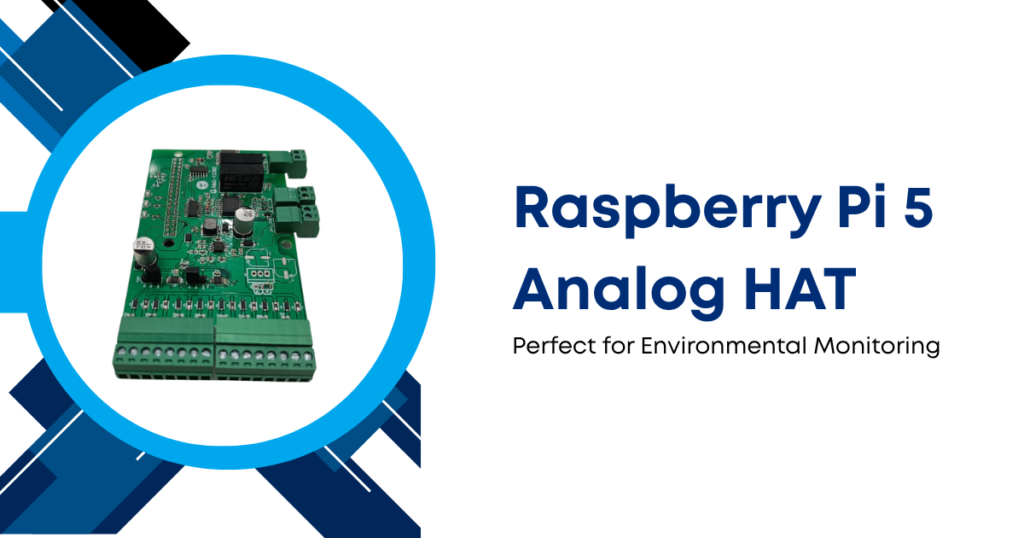
In this setup, a Raspberry Pi 5 Analog HAT becomes highly useful. It allows engineers to connect analog sensors, industrial transmitters, and field devices to a compact computing platform. When combined with modules like the Raspberry Pi 5 HAT-8 AI/2 Rs-485 and other Raspberry Pi 5 HAT options, it supports both analog and digital monitoring in one system.
Why Raspberry Pi 5 Fits Environmental Monitoring
Environmental monitoring workloads look simple on the surface. A sensor sends values. A controller stores them. A dashboard shows graphs.
A field-ready system often needs to:
- Read multiple sensors at once
- Handle noisy electrical environments.
- Store time-series data locally
- Push data to cloud dashboards.
- Trigger alarms in real time
- Run AI or rule-based filtering at the edge.
- Stay stable for long periods.
The Raspberry Pi 5 addresses many of these needs more effectively than older single-board systems.
Key Raspberry Pi 5 strengths
- Faster CPU for data collection and preprocessing
- Better USB and I/O throughput
- Improved PCIe support for expansion
- Mature Linux ecosystem
- Strong Python, C, Node-RED, and MQTT support
- Easy integration with cloud services and local databases
For example, a simple weather node may only log temperature and humidity. But an industrial greenhouse node may need:
- Relative humidity
- CO2
- Light intensity
- VOC or IAQ data
- Fan and irrigation control
- Remote diagnostics
What does an Analog HAT Do?
A standard Raspberry Pi does not have native analog input pins, which limits its use in environmental monitoring. A Raspberry Pi 5 Analog HAT solves this by adding ADCs, voltage input channels, current loop support in some models, signal conditioning, isolation, and extra communication options.
It allows Raspberry Pi 5 to read analog signals such as 0–10V, 1–5V, 4–20mA, resistive outputs, sensor bridge voltages, and conditioned transducer signals. These signal types are still widely used in environmental and industrial sensing.
Why Analog Still Matters in Modern Monitoring?
Many developers assume digital sensors are always better. That is not true in field engineering.
Analog sensors remain widely used because they are:
- Stable over long cable runs
- Common in industrial catalogs
- Easy to interface with transmitters
- Available in rugged enclosures
- Trusted in HVAC, agriculture, and water systems
A greenhouse air sensor, for instance, may expose humidity and temperature through an analog transmitter. A water level probe may output 4–20mA. A soil nutrient transmitter may use analog voltage or current loops.
These sensors often survive harsh environments better than cheap consumer modules.
Common environmental signals you may encounter
- Temperature transmitters
- Humidity transmitters
- Pressure sensors
- Soil moisture probes
- Water level sensors
- pH and EC interfaces
A good Analog HAT makes Raspberry Pi 5 compatible with all of them.
Raspberry Pi 5 Analog HAT Architecture
A proper technical design should treat the Analog HAT as part of a full signal chain, not just a plug-in board.
Typical architecture
Sensor → Signal Conditioning → Analog HAT → Raspberry Pi 5 → Local Processing → Dashboard / Cloud
1. Sensor Layer
The sensor layer includes the field devices that measure physical conditions. These may include soil moisture sensors, ambient temperature transmitters, CO2 sensors, and water tank level sensors. This is the starting point of the monitoring system, where real-world data is captured.
2. Signal Conditioning Layer
Raw sensor outputs are not always ready for direct processing. They may contain noise or weak signals that need improvement. This layer handles tasks such as amplification, filtering, isolation, voltage scaling, and current loop conversion. Some Analog HATs include these features, while others need external circuits.
3. Analog-to-Digital Conversion
This is the main function of the Analog HAT. The ADC converts analog sensor signals into digital values that Raspberry Pi 5 can process. Important factors here include resolution, sampling rate, input range, accuracy, differential input support, and noise performance. For environmental monitoring, stable and accurate readings are usually more important than speed.
4. Edge Processing on Raspberry Pi 5
Once the Raspberry Pi 5 receives the sensor data, it can process it locally. This includes calibration, noise removal, unit conversion, fault detection, alert generation, database logging, and communication with MQTT, Modbus TCP, or cloud platforms. This layer turns the system into a complete smart monitoring node.
Environmental Monitoring Use Cases
A Raspberry Pi 5 HAT setup with analog support works across many sectors.
1. Air Quality Monitoring
Air quality nodes often combine sensors such as temperature, humidity, VOC, CO2, PM2.5, and PM10. Many modern systems use both digital and analog interfaces. Analog channels remain useful for industrial transmitters and calibrated external modules.
Practical Deployment Example: An indoor air quality node in an office or school can sample temperature regularly, track humidity drift, trigger CO2 alerts, and log ventilation trends. Raspberry Pi 5 can also perform edge filtering before sending data.
2. Smart Agriculture and Greenhouses
Agriculture is a strong use case for analog sensing. A greenhouse controller may monitor soil moisture, soil temperature, ambient humidity, light intensity, irrigation pressure, and nutrient solution EC and pH. Some probes use RS485 Modbus RTU, while others still provide analog outputs.
This is where the Raspberry Pi 5 HAT-8 AI/2 Rs-485 works well with an Analog HAT. It supports analog channels for legacy probes, RS485 for industrial sensors, and local processing for smarter monitoring.
3. Water Quality and Utility Monitoring
Water and utility systems often use rugged sensors with industrial outputs. Common measurements include pH, TDS, EC, turbidity, water temperature, tank level, flow, and pressure. Many of these sensors are designed for long cable runs and noisy sites.
A Raspberry Pi 5-based node can be deployed in pump rooms, treatment cabinets, aquaculture systems, irrigation panels, and borewell stations. The Analog HAT reads sensor data, while the Pi manages logic, dashboards, and alerts.
4. Building and HVAC Monitoring
Environmental monitoring also matters inside buildings. A Raspberry Pi 5 HAT system can track room temperature, humidity, duct conditions, IAQ metrics, differential pressure, and equipment heat load. This supports server room monitoring, HVAC balancing, cold storage, and smart office automation.
Why RS485 Matters Alongside Analog
A serious environmental monitoring node should not depend on analog input alone.
That is why boards such as the Raspberry Pi 5 HAT-8 AI/2 Rs-485 deserve attention.
Why RS485 is useful
RS485 is common in industrial sensing because it supports:
- Long cable distances
- Better noise resistance
- Multi-device communication
- Reliable field wiring
Technical references and industrial guides consistently note that RS485 is well-suited for noisy and long-distance environments, and it commonly carries Modbus RTU traffic in automation systems.
Why combine Analog HAT and RS485 HAT?
Because real installations are mixed.
You may have:
- One analog water level transmitter
- Two 4–20mA pressure loops
- Three Modbus soil sensors
- One RS485 air quality sensor
A flexible Raspberry Pi 5 HAT stack lets you support all of them in one node.That reduces hardware fragmentation and simplifies maintenance.
Software Stack for a Raspberry Pi 5 Monitoring Node
The hardware matters, but software decides whether the system feels professional or fragile.
Recommended software stack
- Raspberry Pi OS
- Python
- Node-RED
- MQTT broker
- InfluxDB or SQLite
- Grafana
Typical data pipeline
- Read ADC values from Analog HAT
- Poll RS485 sensors using Modbus RTU
- Apply calibration and scaling.
- Store values locally
- Publish to MQTT
- Show dashboards in Grafana.
- Send alerts by email, Telegram, or API
Example processing tasks
A Raspberry Pi 5 can easily perform moving average filtering, threshold alarms, sensor fault detection, timestamp correction, unit conversion, local trend analysis, and data compression before upload. It can also run lightweight AI models if needed.
Technical Design Tips for Better Accuracy
A monitoring node is only as good as its measurement quality. That means you should focus on engineering basics.
1. Use Proper Power Design
Environmental nodes often fail because of unstable power. Use a clean, regulated supply, surge protection, a separate sensor and Pi power when needed, and battery backup for field use.
2. Protect Analog Inputs
Field wiring can be messy. Protect the Analog HAT with TVS diodes, input filtering, isolation if required, and fuse or resettable protection.
3. Calibrate Every Sensor Path
Never trust raw values blindly. Calibration should include offset correction, gain correction, environmental compensation, and sensor-specific conversion formulas.
4. Keep Cables Short for Analog Signals
Analog lines pick up noise more easily than digital buses. If sensors are far away, prefer 4–20mA loops, RS485 sensors, and shielded cables.
5. Log Diagnostics, Not Just Sensor Values
A good monitoring system should also log read failures, CRC errors, bus timeout events, supply voltage, and internal board temperature.
Challenges You Should Plan For
No platform is perfect. A Raspberry Pi 5 environmental node still needs careful design.
Common challenges
- Analog noise
- Sensor drift
- Modbus register inconsistencies
- Poor field wiring
- Power interruptions
How to reduce risk
- Use industrial-grade sensors
- Add watchdog restart logic.
- Store data on SSD or robust media
- Use sealed enclosures with a ventilation design.
- Keep protocol maps documented.
These steps matter more than adding more features.
Final Thoughts
A Raspberry Pi 5 Analog HAT is a strong choice for environmental monitoring because it connects real-world sensors with modern edge computing. Raspberry Pi 5 handles processing, while the Analog HAT enables physical sensor input. A board like the Raspberry Pi 5 HAT-8 AI/2 Rs-485 further adds industrial communication and smarter edge capabilities.
Together, they support applications such as air quality monitoring, smart agriculture, water systems, building automation, research, and remote telemetry. This is why the Raspberry Pi 5 HAT ecosystem is valuable. It gives engineers a compact and practical platform for collecting, processing, and sharing environmental data.