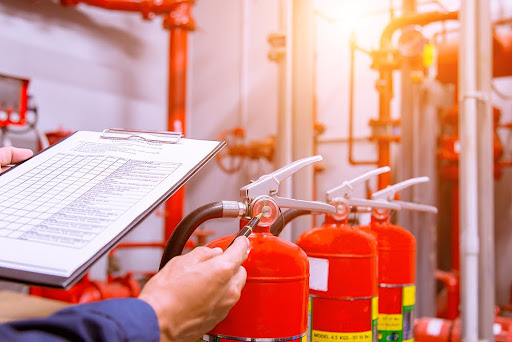
Engineer checking Industrial fire control system,Fire Alarm controller, Fire notifier, Anti fire.System ready In the event of a fire.
Fires have continued to pose one of the greatest risks to residential and commercial areas, as well as to workplaces. An appropriate Fire Risk Assessment would assist in avoiding any possible harm before it becomes a disaster. It is not only a legal obligation in most of the areas, but also an essential measure in safeguarding human life and property.
Organizational awareness of safety standards has increased today, but most organizations continue to neglect the significance of undertaking a structured Fire Risk Assessment. Even minor risks might grow rapidly and result in damage, injuries, or even death without proper planning.
This manual covers all the aspects of Fire Risk Assessment concisely and feasibly. It addresses the process, significance, law, and best practice in order to make individuals and businesses remain ready and in compliance.
Fire Risk Assessment: What and Why It Matters.
A Fire Risk Assessment is an organized procedure that is applied in determining fire hazards, assessing and mitigating risks. It is aimed at minimizing the risk of fire and at preventing its consequences in case it happens. This is vital in the preservation of a secure environment both at homes, commercial and industrial premises.
The significance of a Fire Risk Assessment is beyond compliance. It makes sure that the evacuation paths are open, the fire alarms are working and individuals know how to act in case of an emergency. Through risk assessment, the organisation is able to avoid such incidents and not respond to them.
It also instills trust in the workers, clients, and guests. Trust and reputation are improved when the safety measures are observable and functioning. Periodic inspections also enable the companies to save money that would be lost when fire destroys the premises and the insurance issue arises.
The major actions that are followed in a fire risk assessment are:
There are a number of steps of conduct of Fire Risk Assessment, which guarantee a comprehensive evaluation and risk management. The initial one is to detect the possible fire hazards, including electrical faults, flammable materials, and unsafe use of equipment.
The second step will be to find at-risk people. This covers the employees, visitors and vulnerable people like children or old people. An assessment of how these people can be impacted is an important process that should be evaluated.
The assessor follows up on the safety measures that are in existence after determining risks. This covers fire alarms, extinguishers, emergency exits, and signage. In case gaps are identified, it requires improvements need to be introduced.
Lastly, all the findings are documented, and frequent reviews are planned. Fire Risk Assessment cannot be done once and then left to be, it should be a continual process that requires revision every now and then in order to maintain safety and adherence.
Legal Requirements and Compliance of Fire Risk Assessment.
Fire Risk Assessment is a statutory requirement in most nations for the owners of a property, employers, and business operators. The regulations also demand that responsible persons ensure that the fire risks are managed and recorded appropriately.
Lack of adherence to fire safety laws may attract huge fines, penalties, or even the closure of the business. Inspections can be conducted by authorities to guarantee the presence of a valid Fire Risk Assessment, which is maintained correctly.
Other areas of compliance include staff training and emergency planning. The employee should be trained on the evacuation procedure and how to react when there is a fire breakout. Drills are conducted frequently to support such practices.
It is also important to record assessments, updates, and safety measures. Documentation is evidence of compliance and assists in enhancing safety measures over time.
Fire Hazards that are common during Fire Risk Assessment.
When properly carried out, a Fire Risk Assessment usually identifies some of the common hazards that may result in the occurrence of fire incidents. One of the most common causes is electrical faults, particularly when the wiring systems are either old or of low quality.
Paper, chemicals, and fuel are also flammable substances that pose a great hazard. Storing or handling poorly may raise the risks of fire. Kitchens, industrial zones, and storage rooms are especially prone to it.
The other factor is human behavior. Such irresponsible practices as smoking in confined places or leaving machinery unattended may cause fires. Such risks should be identified to prevent them.
Other problems include blocked exits and absence of effective signage. The Fire Risk Assessment not only provides the escape routes but also provides clear routes whereby one can escape during an emergency.
Advantages of doing a Fire Risk Assessment on a regular basis.
Fire Risk Assessment is regularly carried out with several advantages beyond the safety requirements. Among the most valuable benefits, there is early identification of possible hazards that can be prevented prior to the accidents.
It enhances preparedness to emergencies as well. The response time of the emergencies is greatly decreased when these risks have been identified and dealt with. This would save lives and reduce damage.
Savings in cost is another advantage. Avoiding fire incidents saves on the cost of repairs, insurance claims and downtimes. Companies are able to perform better without sudden disturbances.
In addition, a good Fire Risk Assessment increases morale at the workplace. Workers are more confident as they know that their working environment is safe, and this increases productivity and confidence.
Best Practices for Successful Fire Risk Assessment.
Fire Risk Assessment should be based on best practices, which are aimed at accuracy and consistency to be effective. The initial step towards a quality assessment is to hire qualified professionals or trained personnel.
It is necessary to have frequent checks and updates. Risk may vary with time through the introduction of new equipment or layout adjustments or an increase in occupancy. Safety is maintained by updating the assessments.
There is also the communication that is clear. Fire risks should be explained to the employees and they should be trained on how to deal with fire emergencies. Consciousness is very important in prevention.
It can be enhanced with the help of modern tools and technology. A Fire Risk Assessment will be more efficient and accurate with the help of digital checklists, monitoring systems, and automated alarms.
The way Businesses can make the process of fire safety better.
Companies can reinforce the safety aspect by ensuring that Fire Risk Assessment is incorporated in the general risk management plan. This involves the installation of advanced fire detection and suppression system like sprinkles and fire alarms.
It is essential to maintain equipment regularly. Defective systems may breakdown during emergencies, thus not being useful. There is an in-service inspection to make sure that the safety tools are operating correctly.
Employees should be taken through training programs on a regular basis. Employees are supposed to be familiar with methods of operating fire extinguishers and evacuation procedures. Such experience can be of great help in times of crisis.
Finally, it is important to formulate a culture of safety. When the responsibility of Fire safety is distributed among the parties, the effects of Fire Risk Assessment will be more efficient and enduring.
Conclusion
Fire Risk Assessment is a very crucial process that helps to save life, property, and continuity of the business. It assists in risk identification, putting safety precautions and maintaining adherence to legal standards.
Through periodic evaluations and practice of the best approaches, individuals and organizations would be able to minimize fire risks considerably. It is always good to prevent rather than to deal with the results of an occurrence of a fire incidence.
Good safety planning does not just guarantee protection but also creates a good amount of trust and confidence. Fire safety with proactive safety design of the environment provides a safe environment to all the parties concerned.
Frequently Asked Questions
What does a Fire Risk Assessment entail?
Fire Risk Assessment is a process that is geared towards identifying fire risks, quantifying risks, and putting measures that would prevent the occurrence of fire incidents and ensure safety.
Who carries out Fire risk assessment?
The assessment or the employment of a professional is usually performed by the property owner, an employer, or a responsible person assigned to this task.
How frequently is a Fire Risk Assessment to be conducted?
It must be checked periodically, particularly in the event of building, equipment, or occupancy modification.
Is it a legal requirement to conduct Fire Risk Assessment?
Yes, in most countries the businesses and some residential premises are required to carry out and keep a proper assessment.
What will occur if you fail to do a Fire Risk Assessment?
Having not done one may result in legal sanctions, fines, greater risks, and loss of life and property.