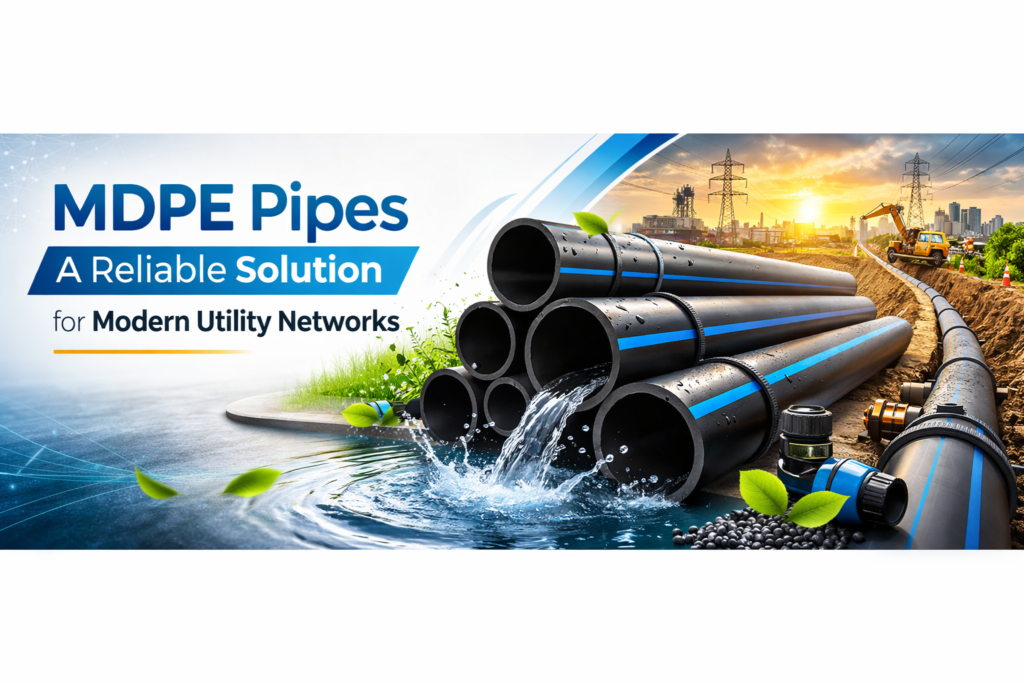
Infrastructure systems need to be built with materials suited to durability, cost-efficiency, and the performance over the long-term. Medium Density Polyethylene Pipe solutions have become highly accepted and used in the industry because they have high resilience, flexibility and a corrosive resistance in the water and gas distribution networks. Based on the requirements of underground conditions and changing pressure, the MDPE piping systems offer reliable performance in municipal, commercial, and residential areas. Using MDPE is anticipated to have advantages which can be measured against conventional metal-based piping materials because utility providers have remained very safety-conscious and Earth-saving with outstanding objectives of saving sustainable benefits to them.
Understanding MDPE Pipes
MDPE Pipes are produced with medium-density polyethylene resin which is a balance of flexibility and mechanical strength. MDPE offers greater resistance to cracking and stress as opposed to high-density, so that it is especially applicable to pressurized utility systems.
A typical MDPE pipe is light in weight, and it is easy to carry, and this saves time and labor expenses incurred in the installation. It has a smooth internal bore, which makes it able to have good flow features, reducing friction losses and optimum performance of the system. MDPE is also extremely resistant to corrosion and therefore there is no need to provide protection to the pipes by coating them or through the deployment of cathodic protection as is the case with the most metallic piping systems.
The structural properties of the material can also enable it to take up small ground vibrations without breaking. This makes MDPE particularly useful in regions that have a volatile soil condition or variable temperature between the environments.
Key Advantages of MDPE Piping Systems
Corrosion and Chemical Resistance
Exposure to moisture and hostile soil conditions does not lead to rusting and scaling, or degradation, in MDPE pipes. Such resistance greatly prolongs the service time and reduces maintenance costs in the long run. It is also durable to many chemicals and hence is suitable in the distribution of potable water and gas.
Flexibility and Impact Strength
MDPE has a high level of flexibility that allows it to take up the surge of pressure and other external loads without breaking. Pipes may be installed with very low quantities of joining to maneuver around obstacles thereby minimizing the potential locations of leak. There is also the support of trenchless installation techniques to this property to limit the disturbance of the environment.
Leak-Free Jointing Performance
Fittings made of MDPE pipe are constructed in a manner that provides a reliable connection in the network of distributions. Compression and electrofusion fittings are used to provide small seals that limit the risk of leakage and system integrity. This performance has to be leak-resistant, and this is critical in the gas supply systems where safety is one of the main concerns.
Long Service Life
The MDPE piping systems are designed in such a way that they can serve decades of operations when used in a normal state. They counter environmental stress cracking and abrasion which guarantees uniformity in both urban and rural installations.
Applications Across Utility Sectors
MDPE piping is popular in drinkable water supply mains, natural gas lines and in irrigation systems. They are used in water infrastructure to ensure water quality by averting contamination and corrosion-induced deterioration. Their abilities to bend and be tough in addition to their strengths improve the safety of operations and minimize joint failure possibilities in gas distribution.
MDPE is also strong and resistant to UV, and this makes it ideal in agricultural and landscaping projects. Its portability makes it an easy-to-install system in large areas of land aiding effective irrigation control.
Installation and Sustainability Benefits
The pipes made of MDPE are considered part of sustainable construction processes because they have a long-life cycle and can be recycled. Emission of water and energy use is minimized through the reduced leakage rates, and overall transportation uses less emissions due to lightweight. Fast installation sequences reduce man-hours and project schedules and enhance efficiency.
Besides, the flexibility of the material to the current joining technologies will guarantee the control of quality throughout field works.
Conclusion
MDPE pipeline systems provide a reliable and economical system in terms of water and gas distribution systems. They are flexible, resistant to corrosion and have a long life to enable them to respond to changing needs of the modern utility network. MDPE offers safe, efficient and sustainable performance in a myriad of environments due to the secure jointing systems and low levels of maintenance.
Source: goflo